Jun. 28, 2021
Cooking In Season
Salad Meals to Beat the Heat
In this recipe round up, I have gathered my best and most delicious summer salad meal recipes in one post, for days when it’s too hot to cook!
Easter is good times in our family. Our first big gathering since Christmas, the return of the spring sunshine, and the weekend feels all about fresh air and smiles rather than food.
We always make something lemony for Easter dessert. Lemon seems to suit the budding fresh springtime energy of the day. Or maybe we are just sick of chocolate after stuffing our faces all day with mini-eggs and Lindt bunny pieces snuck from the children. Not that I am admitting to nicking chocolate from my kids, no way.
On the big day, sometime between picking daffodils, eating chocolate, and dying eggs with the grandchildren, my Mom will make her sky-high lemon meringue pie for Easter dessert.
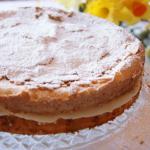
But occasionally I take over and make Lemon Feather Cake instead.
Lemon Feather Cake is one of those recipes – I rarely make it, but let’s just say that it never loses its place in the Top 100 of my most treasured recipes. It combines a light-as-a-feather (gluten-free!) lemony sponge cake with my Granny’s buttery lemon curd filling. It’s light enough to eat at the end of a big meal, but tastes luscious enough to feel like an indulgence.
Just to demonstrate how good Lemon Feather Cake is: I used to, before gluten-free baking became all the rage (and relatively easy to find), make this cake for gluten-intolerant friends just so I could watch them weep with joy.
I had hoped to post about this earlier in the week but I have been too busy with regular life to make this cake twice in one week. (True that, double true.) At any rate, I’m giving you the recipe for this fabulous light and lemony cake, if not in time for you to make it this Easter, at least in time for you to make it this spring sometime – and for sure in time for next Easter.

This recipe is adapted from one I found years ago in the pages of the Canadian Living 20th Anniversary Cookbook. Gluten-free, light, luscious, lemony – a keeper for sure.
Note ~ for a dairy-free version, use the vegan buttery sticks and coconut milk, as directed in the recipe, to substitute for the butter and whipping cream.
Even I, who is not really a citrus dessert person, might try this one!
Yay, Collette! I am honoured 🙂 Let me know how it turns out.
This looks so yummy, I KNOW it will be a huge hit with my in-laws who are gluten-intolerant. Thank you for sharing!
Well here I am sweetheart, a day late and usually a dollar, and change…. short. But always so glad to connect with you. This cake looks delish… I had a meal yesterday that was originally intended as an informal, come on over deal, but I am my own worst enemy. As the sun was shining on the garden and all the seedlings wanting transplantation yet once more. I rallied on in the kitchen. Last year I froze a bunch of big beauty bings and so I thought I’d best start using them up. Instead of strawberries I made my crumble with rhubarb from the garden and frozen cherries. Good choice, although like your lemon feather cake it was not a light finish. I made garlic and chive smashed potatoes that turned out just a bit too loose, roasted veges and then we grilled bacon wrapped sirloin. It was wonderful to spend the whole evening in the dining room chatting with our old friends and planning our next holiday.
You really must come next visit and see the new kitchen. It cries out for Heidi’s stamp of approval.
Love you Auntie Jody
Hi Heidi!
I tried this recipe and it turned out amazing!! The instructions were very easy to follow! Thank you for posting this!!
Hi Heidi,
Just made this recipe this weekend, it was pretty good but I had some challenges – in the recipe you specify Potato Flour and then in brackets Potato Starch – realizing that the two are very different I chose to use Starch as you indicate they are interchangeable in the recipe. What I found is that potato starch when blended into the recipe produces lumps unless it is sifted – I am thinking that the Potato Flour would not do this??
Also with the curd / cream combination – despite the finished curd being very thick and the cream whipped quite stiffly the amount of filling caused the cake to slide around on the base until it oozed all out the sides – I was not expecting this….
Again great recipe but you can please specify which in terms of flour or starch and also if using starch it probably needs to be sifted…
Cheers and thanks for the recipe – I will make it again now that I am familiar with it….
Hi Paul – potato flour and potato starch are actually the same thing, as far as I can tell and as far as I have experienced. Over the years of buying, variously, items labeled potato starch and potato flour I found no change in the product at all – same look, feel, baking properties, etc. I have even noticed the same brand available in the same place was called potato flour for years and then, when switching to new packaging, changed their name to potato starch, again with no change in the product. I would say that, unlike with grains, the “dry” floury part of the potato is just the starch.
Re: sifting – I should definitely have made that more clear. I always sift the starch/flour over the egg yolks (in fact, there is even a picture of that sifting process in the post) but I neglected to mention sifting in the directions. My bad! I will fix that right now. Thank you for bringing this to my attention!
Re: lemon filling – true, it’s not very stiff and the cake slides around when being sliced, although not too badly if you have a very sharp serrated knife and saw with only very gentle downward pressure and if you make sure the lemon curd is very cold when the cream is added. Not perfect, but the filling is so delicious that I haven’t got the heart to change it. If you find this very frustrating, you might serve the cake plain, with the filling as a topping or sauce on the side, with the addition of some fresh berries. It would probably not be so frustrating if you know in advance this will happen, so I will amend the recipe to include this.
Thanks again for your feedback. I’m happy to hear that you will make it again 🙂
H
Thanks Heidi – appreciate the quick reply, as I said the cake was really good, just had my moments!
P.
Was looking for a dessert after a heavy Indian/Thai meal that I am making for friends on Friday. Needed Gluten free & this sounds lovely – nothing like lemon to clear your palate after all the spices, etc. Was addicted to your’almond burgers when ReBar first opened on Johnson Street and then went daily to the new place as it was around the corner from my ofice. My daughter Gratia worked there for a while & of course Billy is a fixture. Am living in Ontario & sure miss my daily fix at the ReBar & now that I have discovered your site will visit it often. Thanks for sharing your wonderful recipes – will let you know how it turns out.
Hi Heidi, I look forward to making this cake for my gluten intolerant friend this weekend. I was wondering if almond flour would also work or it if has to be potato flour/starch?
Hi Grace,
I have never tried this with almond flour. It will work, but the result will be grittier and possibly sticker/wetter/gummier than with the potato flour. Potato flour/starch soaks up a lot of liquid and is super-fine, so it makes a light, airy, fluffy, melt-in-your-mouth texture. Almond flour absorbs less moisture, is higher in fat, and is a much coarser grind than potato flour, so it will make for a denser, richer, possibly grittier cake. But I have made a similar cake with hazelnut flour and it tasted delicious. I would use more almond flour than potato flour. Try 1 cup almond flour for the 1/3 cup potato flour.
Thanks Heidi. I was able to find the potato starch and the cake was wonderful. It was wonderful even though I tinkered with the recipe and halved the sugar in both the cake and the curd. I wasn’t sure what to expect but it turned out fine. When I read recipes I always try to take out extra steps, but sometimes they are important to include! So I wanted to ask you why there is an extra step of adding the lemon juice towards the end. I whipped it in as part of the yolk and sugar which made it a bit more runny, but the cake was still ok when it was cooked. So I was curious, as I am sure there are reasons for these things! Thanks for your great recipes
Lovely recipe and absolutely delicious, even for an amateur like me! On my first attempt, the cake seemed to “deflate” quite a bit in the hour or so after baking, not sure why. Also, it took a long time to bake — about an hour at 350 degrees. I’m wondering if I should have lined both the sides AND the bottom of the pan with parchment paper? Another question… should I have left the cake in the pan to cool completely (overnight) before turning it out?
No problems with the filling… it was GREAT!
Hi Debra,
Mine often deflate a bit as well; it’s normal for sponge cakes to do this. If it has deflated a lot, though, that could be a sign of various things: your oven temperature reading isn’t accurate (this is very common: I have to use an oven thermometer in my oven for accuracy); the cake wasn’t fully cooked; or the whites were over-beaten. But sponge cakes are finicky and can react to thinks like ambient humidity. Shrug. I serve the cake with extra filling at times like there 🙂
Definitely don’t line the sides of the cake pan with parchment paper. Having parchment-lined sides allows no grip for the sponge cake batter to hold its shape while it’s rising in the oven. Yes, if you can leave the cake in the pan until it’s completely cooled, that would be best.
I’m glad you tried and enjoyed the recipe!
I love this cake. its simplicity makes it even more appealing to me. I will make it soon. I have the potato starch, I use it often and the cakes are light as air. That lemon cream filling is delicious!
Thank you, Nicoletta!