Jun. 28, 2021
Cooking In Season
Salad Meals to Beat the Heat
In this recipe round up, I have gathered my best and most delicious summer salad meal recipes in one post, for days when it’s too hot to cook!
This post has been sponsored by Rancho Vignola.
Of all the ingredients I introduce to students in my Indian cooking classes, the one that holds the most fascination is the curry leaf. Most students have never heard of it before, and usually someone asks if they can grind it up to make curry powder.
Curry leaves do not make curry powder when ground up on their own, but they are nevertheless an essential flavour component in many Indian dishes, including in some masalas (dry spice mixtures). They have a pungent aroma: a mixture of musk, citrus, and resinous garlic, with a faint curry-like flavour to top it off.
Curry leaves are unlike any other spice in my kitchen. They are a must-have for me: their flavour positively addicting, bringing me back to my months in India, devouring scores of delicious meals perfumed with curry leaf. They are often what separates an authentic tasting Indian dish from one that is lacking in some way.
The word “curry” comes from a Tamil word that means “sauce” or “gravy”. I therefore dub curry leaf the Awesome Sauce Leaf: the leaf that makes all sauces taste and smell amazing.
Curry leaves are usually sauteed in oil to release their essential oils, before being cooked into a dish. This can happen either near the beginning or near the end of cooking. If it happens near the end (as in the recipe for South Indian Dhal in this post), it’s an important spice-tempering technique known as chaunk (Hindi), baghar (Urdu & Bengali), or tarkha (Punjabi), among other names.
Curry leaves can be eaten after cooking, but most often, I move them to the side of my plate as I eat. Smaller ones are more delicate and easily eaten, but bigger leaves are tougher and best to leave aside.
When I can, I buy curry leaves fresh. The rest of the time, I make do with dried. Dried curry leaves are far less aromatic and flavourful, so I double the amount when using them in recipes that call for fresh. When I do find fresh curry leaves, I usually buy much much more than I need, and dry or freeze some for future use. Curry leaves keep about a week or two in the fridge, about 6 weeks in the freezer, or about a year dried.
Fresh curry leaves can be found in Victoria occasionally at the following places: The Root Cellar, Fairway Market at Quadra/Hillside, Gobind Food Market, and Fisgard Market. In Vancouver, they are always available at South China Seas Trading Company, or numerous stores in the neighbourhood known as Little India (on 49th & Main). Dried curry leaves can be found at any Indian or Middle Eastern Spice store.

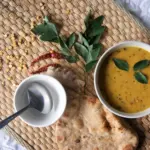
This delectable dhal is a classic South Indian recipe. Most of its flavour comes from a chaunk (spice temper) poured in at the end. The earthiness of the cumin, the sharp pungency of the mustard seeds, the aroma of the curry leaves, and the warm spice of the red chili is a fantastic foil for the slightly sweet lentils. Serve with rice, flatbread, and a vegetable to make a full meal.
Note ~ This recipe uses yellow split peas instead of the South Indian standard, thoor dhal. Feel free to sub in thoor dhal for some or all of the split peas and lentils in this recipe.
Jun. 28, 2021
In this recipe round up, I have gathered my best and most delicious summer salad meal recipes in one post, for days when it’s too hot to cook!
Oct. 25, 2020
Quince have a wonderful flavour, but an almost impossibly hard texture. Read on for a quick kitchen tip that makes quince easy to peel and cut!
Sep. 27, 2020
Pumpkin spices scones are a perfect fall treat; not-too-sweet, fragrant with spices, with a full complement of rich pumpkin flavour.
Sounds like a great recipe to try – please enter me for the draw.
My husband LOVES dhal! I’ll have to give this recipe a try.
I am intrigued at this dhal recipe asking for as many as 25 curry leaves. I might have usd 2-5, I hope it’s not a misprint. look forward to trying it soon. Thanks Heidi.
Hazel
Yes, 25! Definitely not a misprint. Generally curry leaves are used in amounts from 10 to 30 per recipe 🙂
Thank you for sharing the great dhal recipe. Please enter me into your draw. Thanks
I love your passion for curry leaves! Your description of their musky, citrusy flavor and their essential role in authentic Indian cuisine is spot on. It’s great how you educate your cooking class students about this unique ingredient, dispelling myths about curry powder. Your tips on using fresh versus dried curry leaves are really helpful—I’ll be sure to look for them at my local Indian spice store. Thanks for sharing your insights and spreading the love for curry leaves!
Hi Bismi, thank you so much! To answer your question re: dried curry leaves: I find that their flavour is much weaker, so I use double the amount called for and kind of crush them up lightly in my hand before using them, to help release their flavour compounds.