Jun. 28, 2021
Cooking In Season
Salad Meals to Beat the Heat
In this recipe round up, I have gathered my best and most delicious summer salad meal recipes in one post, for days when it’s too hot to cook!
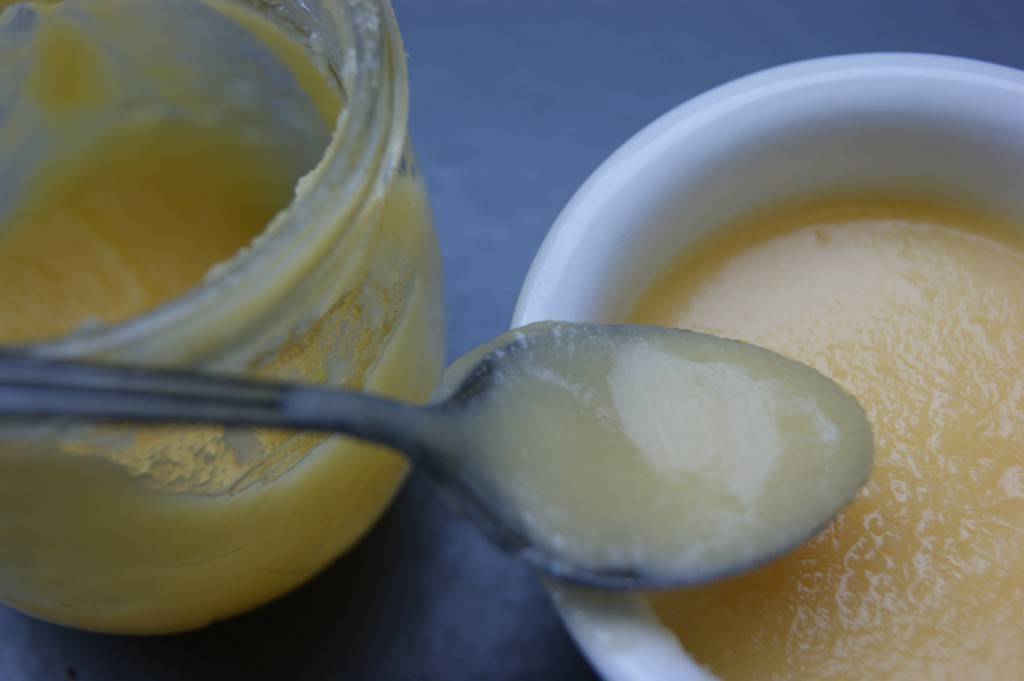
I make ghee in at least half of my cooking classes, and not just the Indian ones. But, although my cooking class students always get to taste the delicious results, they never get to see the process.
Honestly, I’m not a negligent culinary instructor – I just need the ghee right away in class. I don’t have time to wait a delicious half an hour while the butter caramelizes and gets beautifully nutty in the pan. So I make ghee before class and teach how to make it via elaborate descriptions of the process and the results, with a recipe to take home.
Also, my students get to gaze confusedly into a pot of caramelized milk solids or a cheesecloth covered with the same.
While I hope all my students are ghee experts by now, I worry that a significant number are still completely confused about it. So I thought it was time to give a little blog class on how to make ghee.
Ghee, for those who don’t already know, is a kitchen wunderkind in the form of caramelized clarified butter. It has a higher smoke point than butter, a better flavour than butter, keeps better, cooks better, all around better than butter. (Did I just say that? But I LOVE butter!)
Let’s get technical for a minute. Butter is only about 85% fat; the rest is made up of water and milk solids. When you cook with butter and it burns, you can blame that on the milk solids, which are sugary and don’t cope well with high temperatures. To turn butter into a superior (i.e. non-burning) cooking fat you need to get rid of the milk solids. To clarify butter, you evaporate the excess water and separate out the milk solids from the pure butterfat. Easily done by melting butter in a pot, simmering it gently for a few minutes to evaporate the water, setting it aside for a few minutes to let the milk settle below the pure fat, and finally scooping or pouring off the pure butterfat.
In India, cooks take this process one step further. After the milk solids have separated from the butterfat, the butter is NOT poured off and separated, but left on the heat until the milk solids (which are sugary, remember?) caramelize on the bottom of the pan, flavouring the butterfat with their sweet, toasty, nutty, butter-tart like aroma. After you strain out the caramelized milk solids, you are left with ghee, a golden exilir to make all your cooking dreams come true.
Also, ghee is lactose-free.
Seriously, if you want to get right into cooking, Indian cooking especially, you need to have ghee on hand. So here is how to make it.
GHEE
Yield: 1-1/2 to 1-2/3 cups
Start with one pound of fresh unsalted butter. Cut it into cubes and place them in a medium-sized pot with a heavy bottom.
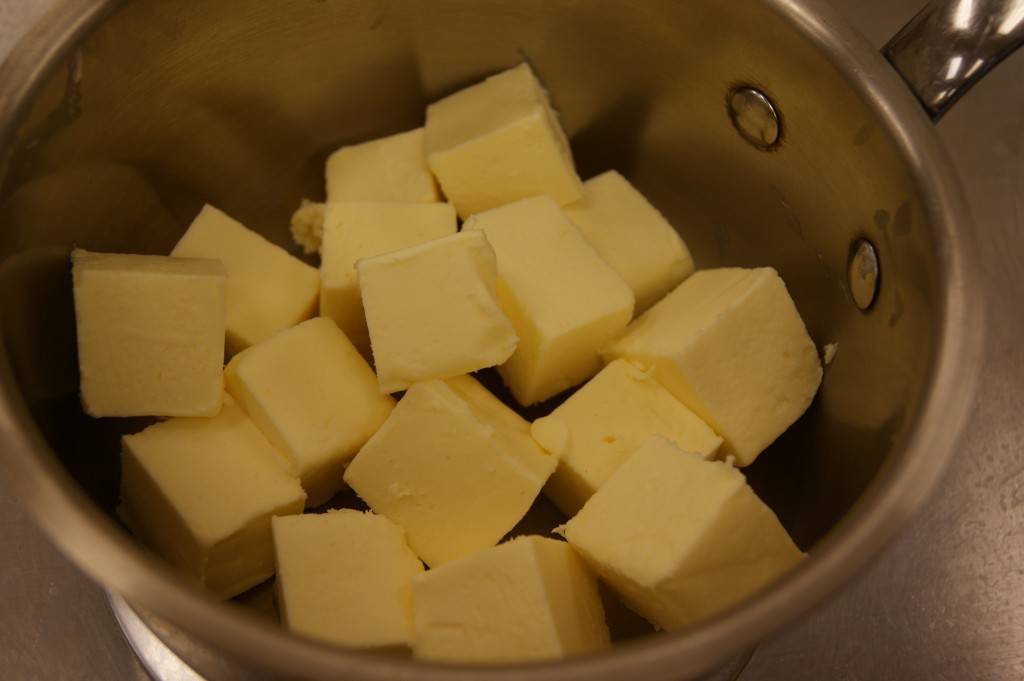
Place the pot on a stove element and turn to medium heat. Melt the butter. Turn the heat down to medium low. While you are making ghee, make sure the butter is at a very, very gentle simmer. Adjust the heat accordingly, depending on your own stove.
After a few minutes, the butter will look like this:
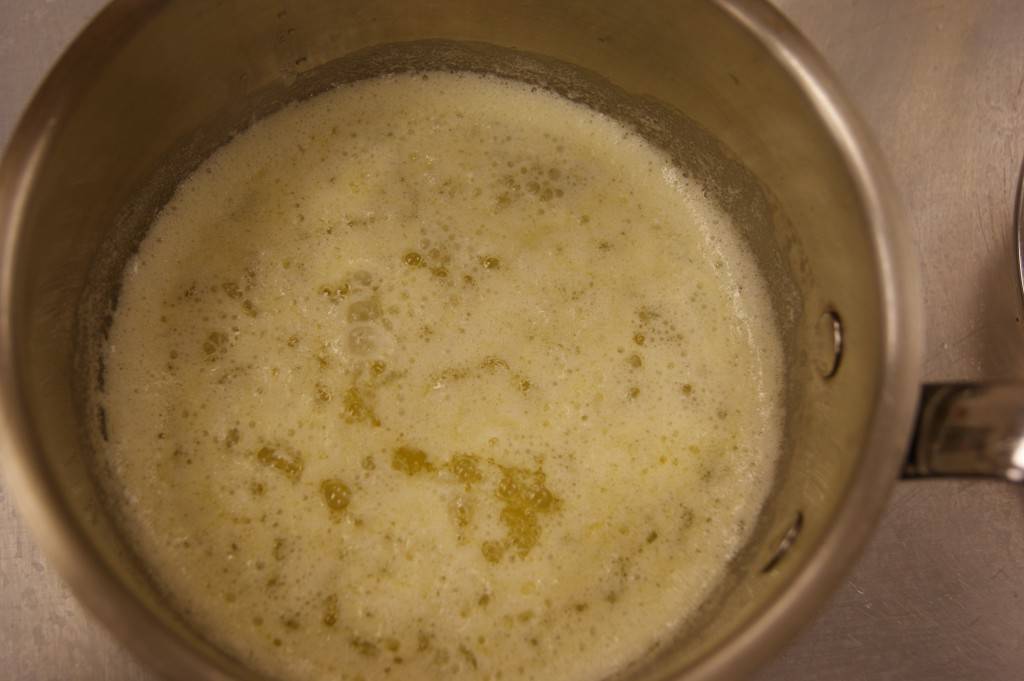
After about 10-13 minutes, the butter will look like this:
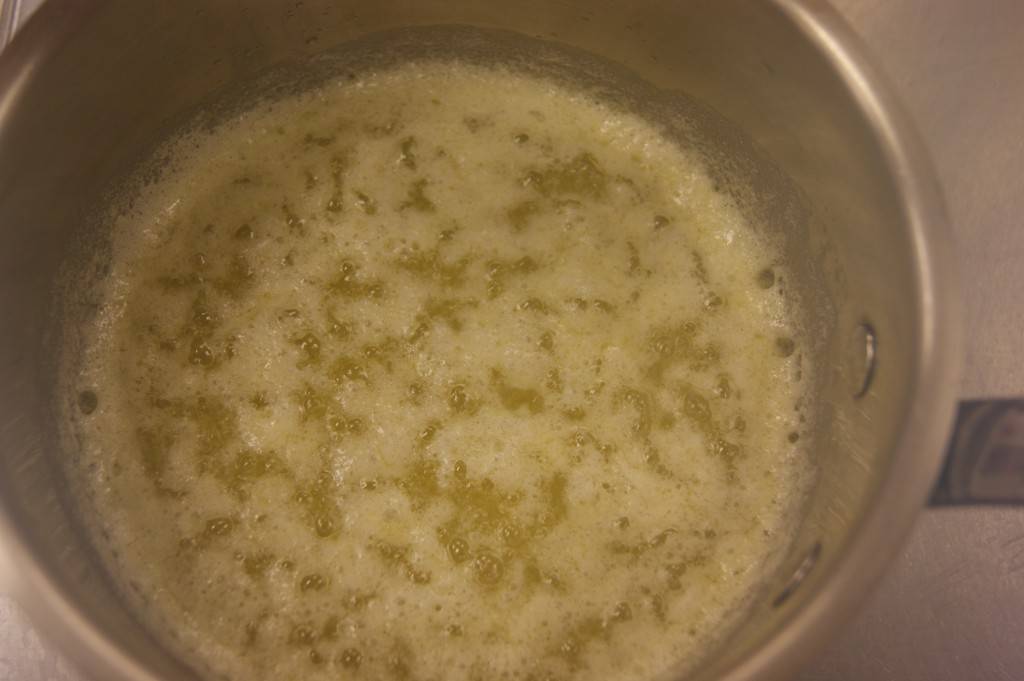
After about 20-25 minutes, the butter will look like this: (it’s very close to being ready! you should see some lightly caramelized milk solids on the bottom of the pan.
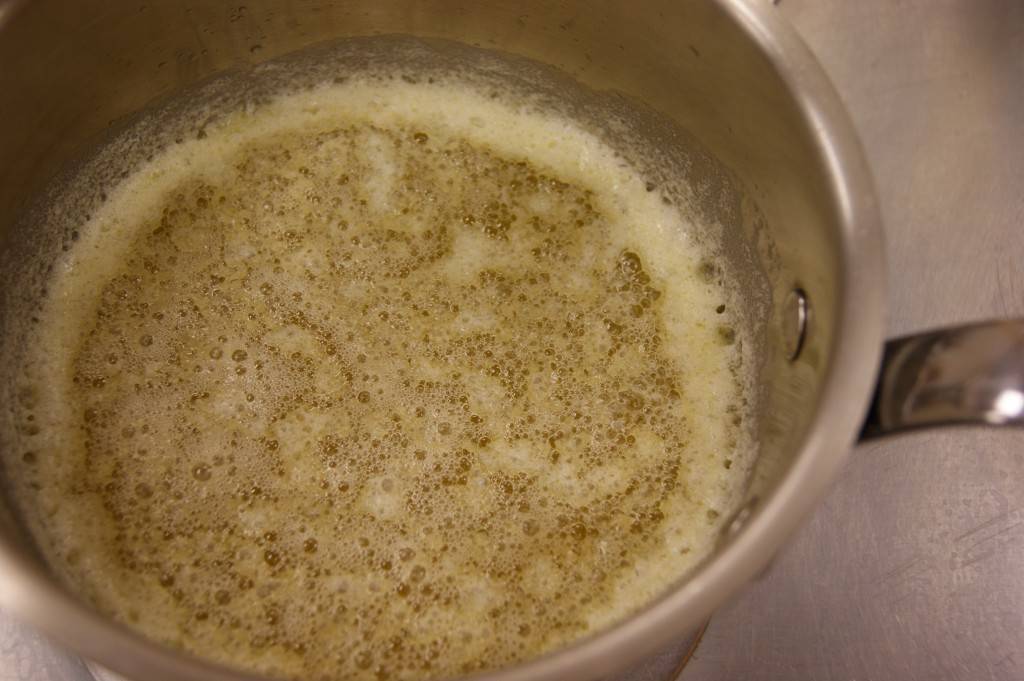
At this point, watch the butter very carefully. It can go from perfect to burnt in no time flat. This is what perfect caramelization looks like, in two pictures:
(Note – ghee can be a little less or a little more caramelized than this. Use your own taste as a guide. If your ghee gets away from you and gets quite dark, it is probably still useable. Only if the milk solids are completely black is the ghee ruined.)
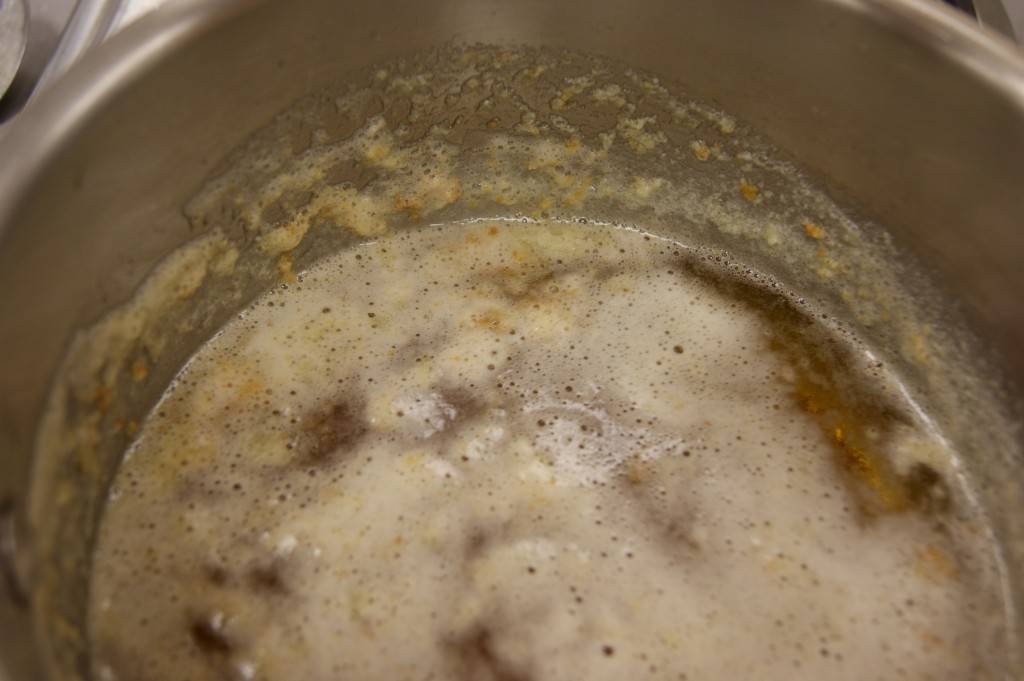 Side view
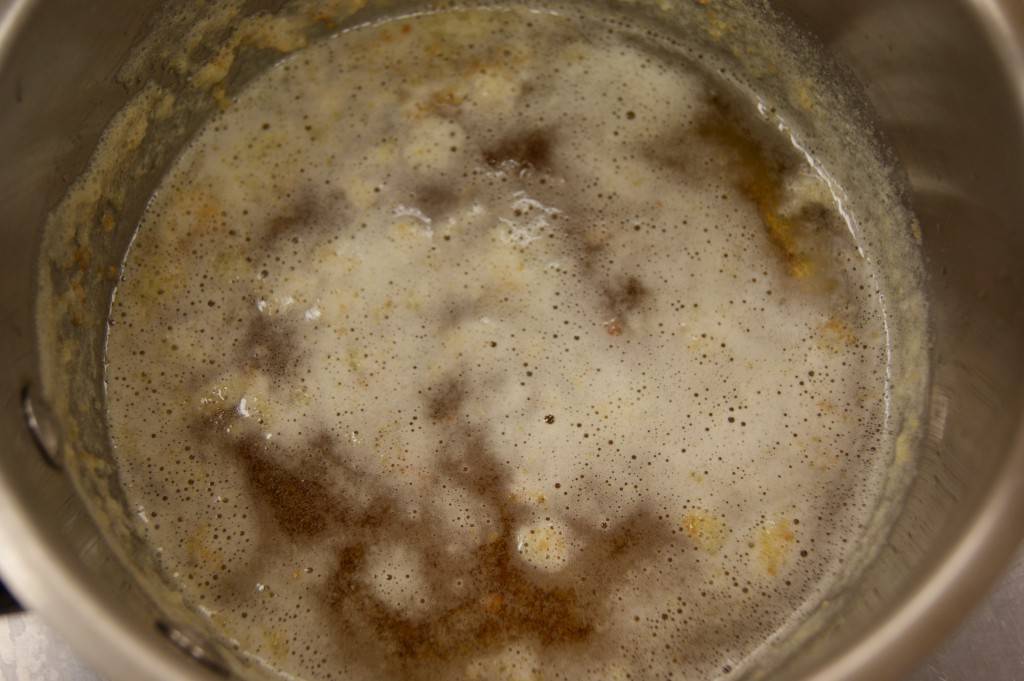
Top-down view
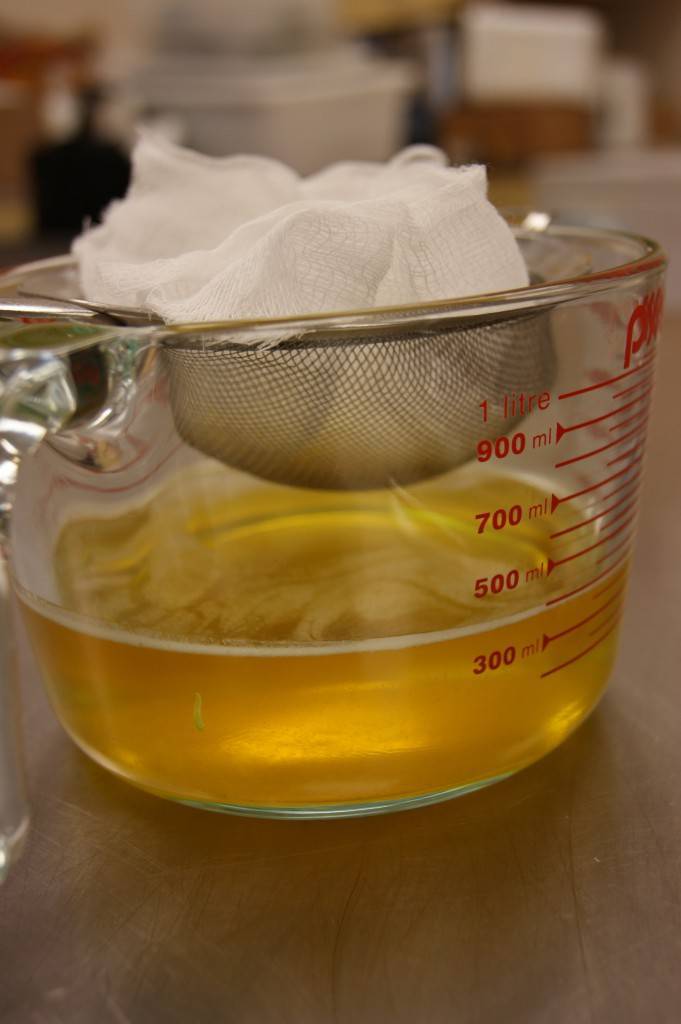
At some point during the process of waiting for the butter to ghee, you will set up a small strainer, lined with several layers of cheesecloth, suspended over a bowl or a large measuring cup.
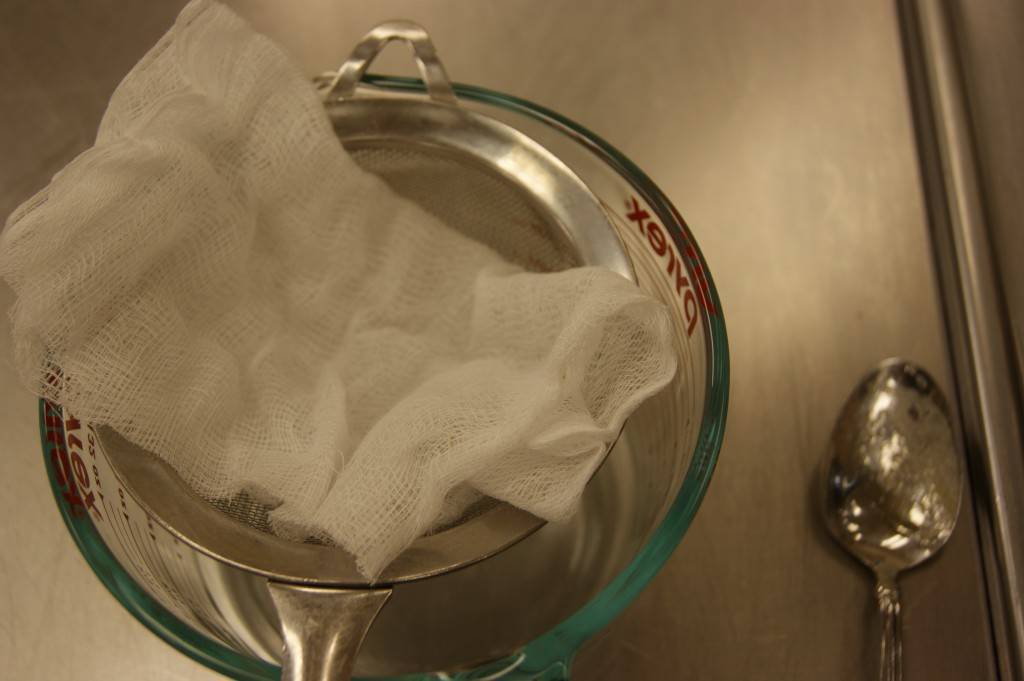
When it is ready, pour the ghee through this cheesecloth-lined strainer. This step, although fussy, is very very important. It’s tempting to imagine that you can leave the milk solids behind in the bottom of the pan and do away with the straining, but any bit that gets into your ghee (and believe me, some will get in if you don’t strain it) will make the ghee go bad very quickly.
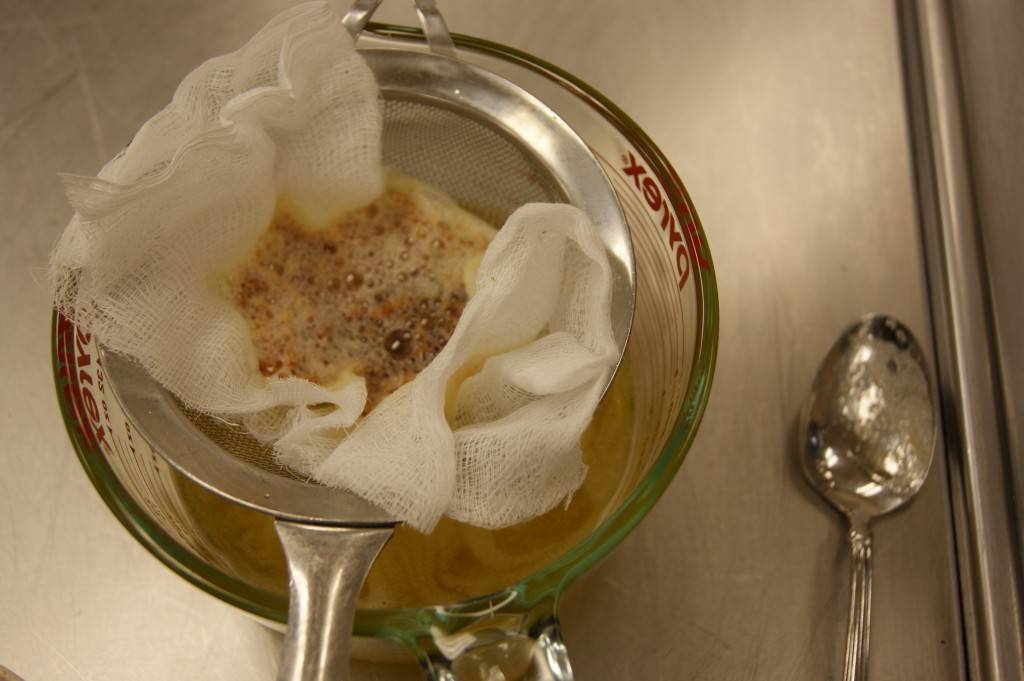
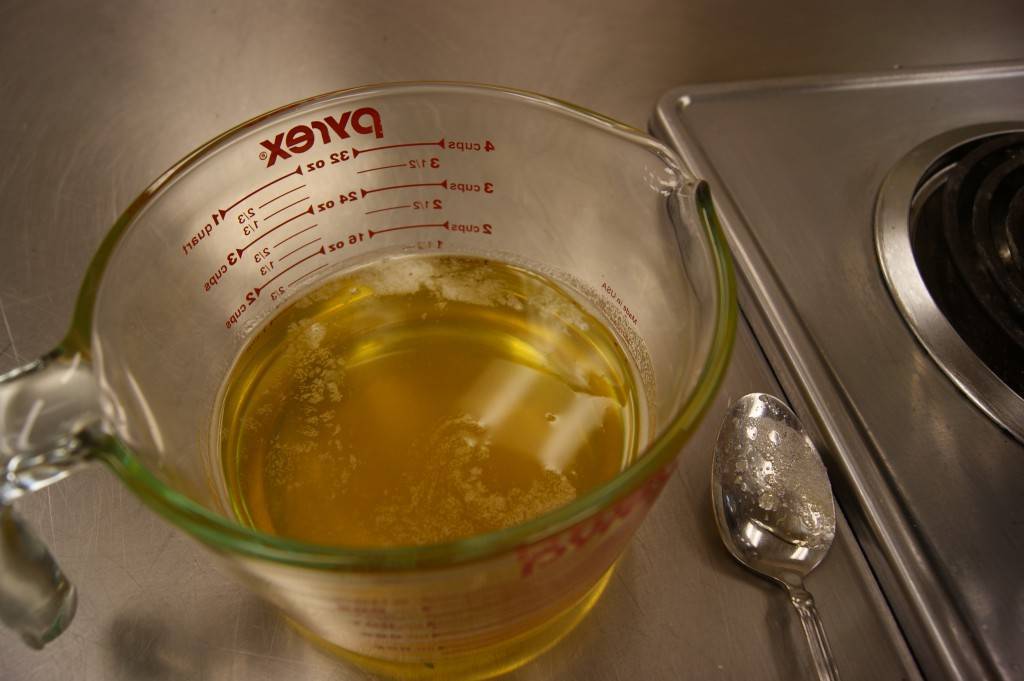
After straining, you will be left with this golden liquid of perfection (isn’t it so pretty?!):
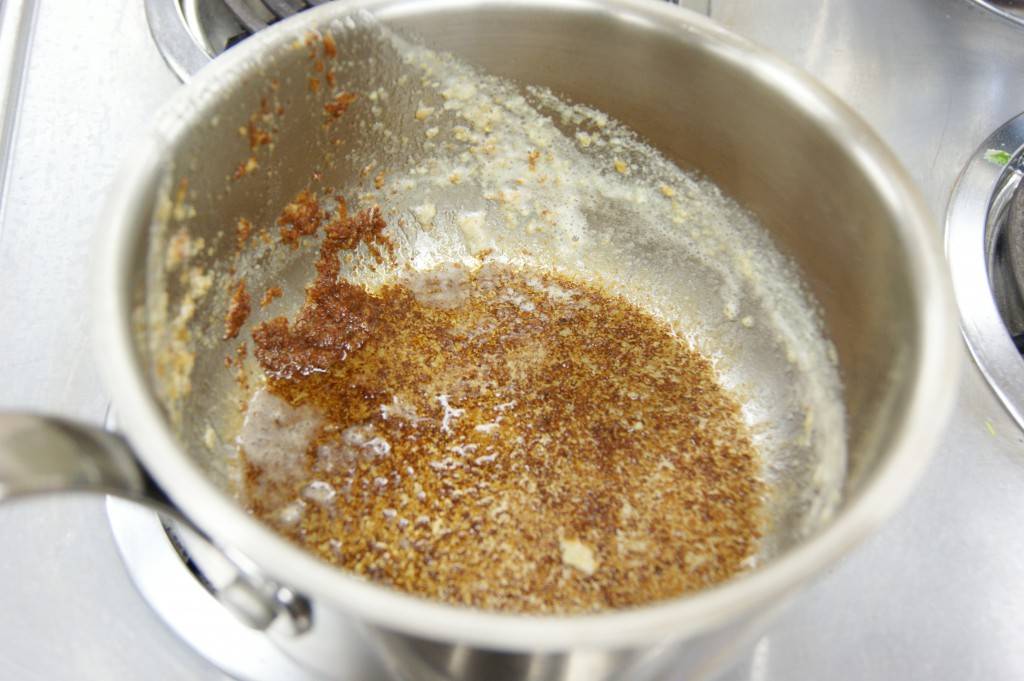
This is what the bottom of your pan will look like after you strain off the ghee. Don’t worry, the clean up is much easier than it looks. (As an aside, caramelized milk solids are actually very tasty. Try them spread on some bread.)
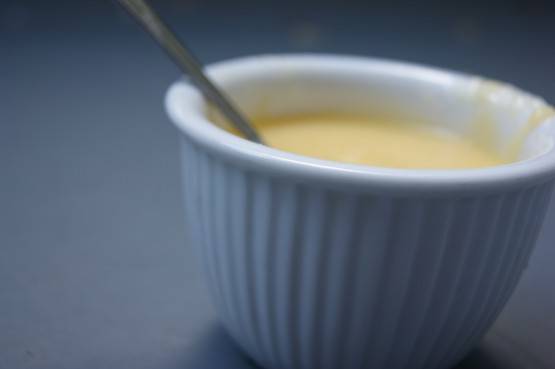
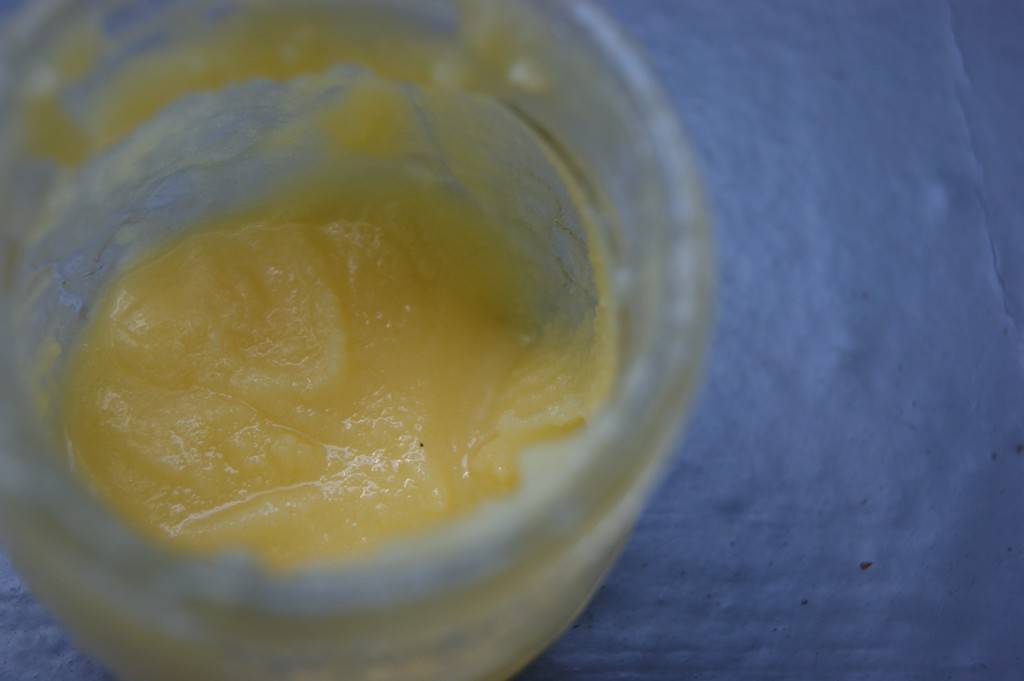
This is what the ghee looks like when it cools down. It is spoonable at room temperature, and very hard in the fridge. I usually store mine in a glass jar in the fridge, with some left out in a ramekin by the stove to use in cooking during the week. 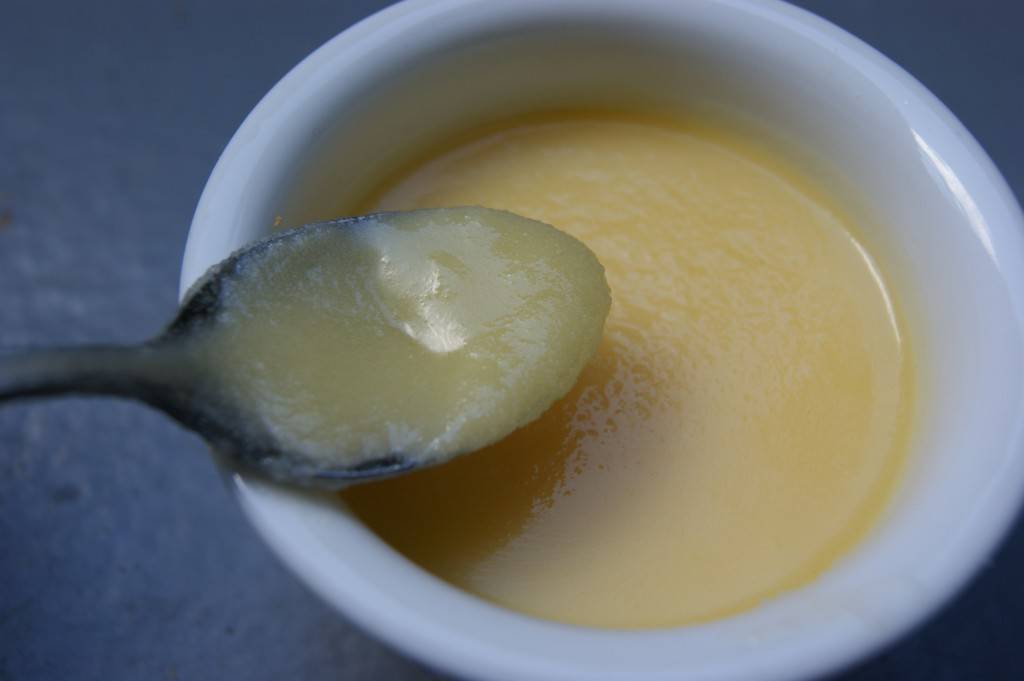
Ghee keeps at room temperature for at least a month, and keeps for a long time in the fridge (I’m tempted to say “indefinitely”, but the ghee never lasts that long around here – I use it up too quickly.)
Finally, what does a person do with ghee? Aside from using it to make delicious Indian food (think ghee-soaked naan, cauliflower simmered in spices and ghee, ghee-toasted almonds atop cardamom rice pudding), I use ghee for cooking vegetables, meats, fruits, desserts, everything. Ideas:
Jun. 28, 2021
In this recipe round up, I have gathered my best and most delicious summer salad meal recipes in one post, for days when it’s too hot to cook!
Oct. 25, 2020
Quince have a wonderful flavour, but an almost impossibly hard texture. Read on for a quick kitchen tip that makes quince easy to peel and cut!
Sep. 27, 2020
Pumpkin spices scones are a perfect fall treat; not-too-sweet, fragrant with spices, with a full complement of rich pumpkin flavour.
I use ghee in my diet and it really helps me to maintain good health. I feel a lot better and my skin problems are also cured by using ghee.
Thanks for sharing this easy method to making ghee.
You are welcome, Ankit!
Hello and thank you. Can I use ghee in place of butter in my baking (mainly cakes) and if so do I use the same amount? It seems like it would make my cakes and frosting far yummier. Cherrs, Joyce
Hi Joyce,
yes, you can! You use the same amount.
YES!!!! Fabulous! Ghee Nation….. ;-)))
Dear Heidi-the way I prefer to separate ghee is after you’ve browned it, pour contents into tall plastic container (or “French working glass”) then refrigerate. Let set. Turn it upside down & use the milk solids to flavor whatever you like-scrambled eggs or dip bread into it, but when you use cheesecloth, you’re throwing all that brown milky goodness away yes> Love your blog. ty!
Hi Maureen, Don’t worry, I keep the caramlized milk solids from the strainer! They are delicious, I agree!
Such a lovely and detailed explanation! 👏 Making ghee at home truly brings back the essence of traditional Indian kitchens. I’ve been using pure A2 desi cow ghee for a while now, and the taste and aroma are unmatched. The benefits of A2 desi cow ghee are amazing from better digestion to improved immunity.
For those who don’t have time to make it themselves, you can easily buy A2 desi ghee online — there are some great brands offering homemade-style A2 ghee with rich flavor and authentic texture. Truly, nothing beats the golden goodness of natural A2 ghee! ✨